

General description
Small conductance calcium-activated potassium channel protein 2 (UniProt P70604; also known as SK2, SKCa 2, SKCa2, KCa2.2) is encoded by the Kcnn2 gene (Gene ID 54262) in rat species. Small conductance calcium-activated potassium channels mediate cell membrane repolarization following intracellular Ca2+ increase induced by various stimuli, thereby restoring an excited cell back to its resting state. SK2 is involved in afterhyperpolarization (AHP) that follows action potentials in vertebrate neurons. SK2 regulates neuronal excitability by contributing to the slow component of synaptic AHP. Ca2+ activates SK2 through the Ca2+ sensor calmodulin (CaM), which can bind up to four Ca2+ ions. The dynamic coupling between Ca2+ binding to CaM, CaM binding to SK, and the open probability of SK are all essential components of the SK2 activity.
~45 kDa observed. 63.85 kDa (rat), 63.76 kDa (human isoform 1), 26.34 kDa (human isoform 2), 91.60 kDa (mouse) calculated.
Immunogen
Epitope: C-terminal cytomplasmic region.
Linear peptide corresponding to a C-terminal cytoplasmic domain sequence of rat SK2 (KCa2.2).
Application
Anti-SK2 (KCa2.2) Antibody, clone K78/29 is an antibody against SK2 for use in Western Blotting, Immunohistochemistry (Paraffin).
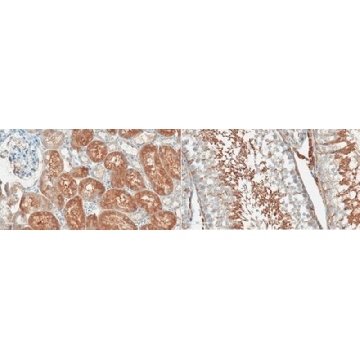
Immunohistochemistry Analysis: An 1:50 dilution from a representative lot detected SK2 (KCa2.2) immunoreactivity in human cerebellum, human cerebral cortex, mouse brain, mouse skeletal muscle, rat kidney and rat testis tissue sections.
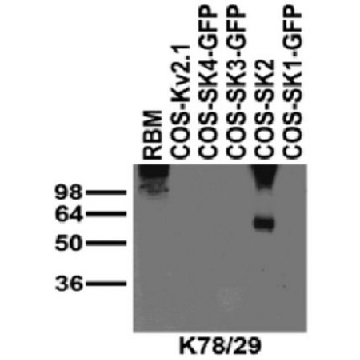
Western Blotting Analysis: A representative lot detected the transiently expressed rat SK2 (KCa2.2), but not SK1 (KCa2.1), SK3 (KCa2.3), SK4 (KCa3.1, KCa4), or Kv2.1 constructs in transfected COS-7 cells (Courtesy of Professor. James S. Trimmer, UC Davis, CA, USA).
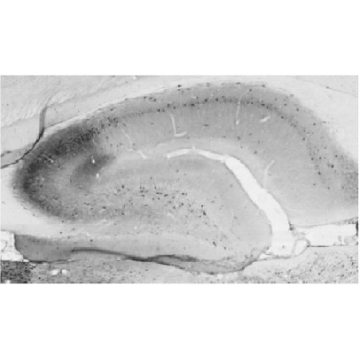
Immunohistochemistry Analysis: A representative lot detected SK2 (KCa2.2) immunoreactivity in adult rat brain hippocampus sections (Courtesy of Professor. James S. Trimmer, UC Davis, CA, USA).
Research Category
Neuroscience
Research Sub Category
Ion Channels & Transporters
Biochem/physiol Actions
Clone K78/29 detects endogenous KCa2.2 in rat brain membrane extracts, as well as the transiently expressed rat SK2 (KCa2.2), but not SK1 (KCa2.1), SK3 (KCa2.3), SK4 (KCa3.1, KCa4), or Kv2.1 constructs in transfected COS-7 cells. Exprected to react with both spliced isoforms of human KCa2.2 reported by UniProt (Q9H2S1).
Physical form
Format: Purified
Protein G Purified
Purified mouse monoclonal IgG1κ antibody in buffer containing 0.1 M Tris-Glycine (pH 7.4), 150 mM NaCl with 0.05% sodium azide.
Preparation Note
Stable for 1 year at 2-8°C from date of receipt.
Analysis Note
Evaluated by Western Blotting in rat brain tissue lysate.
Western Blotting Analysis: 2.0 µg/mL of this antibody detected SK2 (KCa2.2) in 10 µg rat brain tissue lysate.
Other Notes
Concentration: Please refer to lot specific datasheet.
Disclaimer
Unless otherwise stated in our catalog or other company documentation accompanying the product(s), our products are intended for research use only and are not to be used for any other purpose, which includes but is not limited to, unauthorized commercial uses, in vitro diagnostic uses, ex vivo or in vivo therapeutic uses or any type of consumption or application to humans or animals.
| biological source | mouse |
| Quality Level | 100 |
| conjugate | unconjugated |
| antibody form | purified antibody |
| antibody product type | primary antibodies |
| clone | K78/29, monoclonal |
| species reactivity | human, rat, mouse |
| technique(s) | immunohistochemistry: suitable (paraffin),western blot: suitable |
| isotype | IgG1κ |
| NCBI accession no. | NP_062187 |
| UniProt accession no. | P70604 |
| shipped in | wet ice |
| target post-translational modification | unmodified |
| Gene Information | human ... KCNN2(3781) |
