
General description
Dorsomorphin got its name due to its ability to induce dorsoventral patterning abnormalities in zebrafish, a characteristic trait of BMP-pathway mutant embryos. Structurally, dorsomorphin is identical to compound C. Dorsomorphin induces stem cell differentiation, suggesting potential therapeutic implications for fibrodysplasia ossificans progressiva (FOP), a progressive muscle and bone disease. Besides its BMP signaling inhibition, dorsomorphin also hinders the vascular endothelial growth factor (VEGF) type 2 receptor (FLK1/KDR) and disrupts angiogenesis during zebrafish development.
Application
Dorsomorphin has been used:
- as an inhibitor of adenosine monophosphate-activated protein kinase (AMPK) to find the effects of trans-resveratrol on lipid mobilization in 3T3-L1 (a murine cell line of adipocytes) cells
- as an AMPK inhibitor, to indicate the involvement of AMPK/mTOR (mammalian target of rapamycin) pathway in LRG (liraglutide) -induced autophagy
- in the induction step, employed in in vitro differentiation of Friedreich′s ataxia (FRDA) and induced pluripotent stem cells (iPSCs) to neurospheres and neurons using ES (embryonic stem cell) media
Biochem/physiol Actions
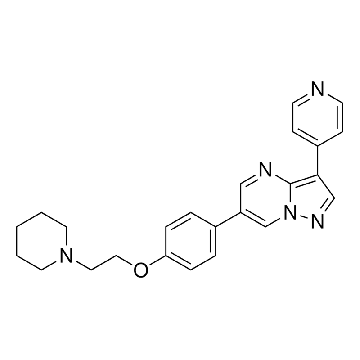
BMP Inhibitor; Cell-permeable pyrrazolopyrimidine compound that acts as a potent, selective, reversible, and ATP-competitive inhibitor of AMPK (AMP-activated protein kinase; Ki = 109 nM in the presence of 5 μM ATP and the absence of AMP).
Dorsomorphin is a selective inhibitor of Bone morphogenetic protein (BMP) signaling. It has been found to inhibit BMP signals required for embryogenesis and promoted significant neural differentiation from human pluripotent stem cell (hPSC) lines. Dorsomorphin also acts as a potent, selective, reversible, and ATP-competitive inhibitor of AMPK (AMP-activated protein kinase); Ki = 109 nM in the presence of 5 μM ATP and the absence of AMP).
Features and Benefits
This compound is a featured product for Kinase Phosphatase Biology research. Click here to discover more featured Kinase Phosphatase Biology products. Learn more about bioactive small molecules for other areas of research at sigma.com/discover-bsm.
This compound is featured on the AMPKs page of the Handbook of Receptor Classification and Signal Transduction. To browse other handbook pages, click here.
| Quality Level | 300 |
| assay | ≥98% (HPLC) |
| form | powder |
| storage condition | protect from light |
| color | white to beige |
| solubility | DMSO: >2 mg/mL (warmed) |
| storage temp. | 2-8°C |
| SMILES string | C1CCN(CC1)CCOc2ccc(cc2)-c3cnc4c(cnn4c3)-c5ccncc5 |
| InChI | 1S/C24H25N5O/c1-2-12-28(13-3-1)14-15-30-22-6-4-19(5-7-22)21-16-26-24-23(17-27-29(24)18-21)20-8-10-25-11-9-20/h4-11,16-18H,1-3,12-15H2 |
| InChI key | XHBVYDAKJHETMP-UHFFFAOYSA-N |
